Showing posts with label editorial. Show all posts

Dec 12, 2014

Venomaniac Origins: Alex Thompson

About three years ago, I was bought a box of comics from eBay claiming that over 27 different issues of Venom were in said box. What I knew was that they were complete series which ran throughout the '90s and early millennium, and as I opened the box I found one comic that stuck out to me—and this comic happened to be the beginning of my obsession with Venom and symbiotes. The joy I gained over my college years after receiving this box lead me further into my interests in writing. Without the oozing smile of Venom, I may have never learned how exciting the world of comics could be.

Read the entire Venom: Lethal Protector series digitally on comiXologyThe foil cover made it stick out like a sore thumb and the crisp look of the art gave me a nostalgic vibe from when I had seen the Spider-Man cartoons on television as a kid. Eddie Brock was the man and this book launched what I thought to be a great start to his long adventure in Marvel comics. The Venom: Lethal Protector series gave Eddie his own town to save under the streets of San Francisco. Here they learned to accept him and his extreme ways, but what really set it out was that the reader could finally get some more depth into his ideas of being an anti-hero. As his adventure continued through the series, Eddie would encounter some interesting foes as he fought for the people of the underground world.

Later throughout the '90s, Eddie would learn and pick up different traits as his symbiote would adapt more to battle and create a better bond between parasite and host. Eddie hit his extreme, though, when his symbiote acquired a taste for brains in Venom: The Hunger. The Venom symbiote continues to live on in Guardians of the Galaxy, and currently is in a story arc right now titled Planet of the Symbiotes.

Discover the symbiote homeworld in Guardians of the Galaxy: Planet of the Symbiotes
I had never read anything about Venom before Lethal Protector, and I am happy that I was able to start here and then journey through Funeral Pyre, The Hunger, Nights of Vengeance, and many more. A lot of people consider the '90s to be some bad years for comics, but to someone like me it feels like the golden years of Marvel. Today, Eddie wanders in obscurity as Toxin and there are still no future plans for him that we can see, but we can still wish.

What were some of your first Venom or symbiote comics? Comment and let us know, and don't forget to follow A Dose of Venom every Friday for new content, as well as The Venom Site for all of your symbiote news, reviews, and point-of-views!

Nov 21, 2014

Is the Marvel WOH What If? Venom Card Unreasonably Priced?

As Marvel War of Heroes starts to dwindle in popularity, the prices of cards continue to increase. The ridiculousness of some of the values of the cards leaves one wondering if, to keep up, they need to sell a organ or dip into life savings. The values of some cards can go all the way up to over $1,000 and the end of the card game is nowhere in sight. A few months ago they introduced a new level of cards called Ultra Legendary, which made the regular market plummet but the ceiling for prices increase.

Also with the addition of Odin Decrees, regular cards can be boosted to new attack/defense levels but leaves the chance of theft high because you cannot trade these boosters and are forced to trade your card to a sometimes unknown seller for them to boost your card for you. The company who created the app for smartphones, Mobage, is usually not known for being very customer-friendly, but is innovative in the ways of business. With prices ever increasing, this makes it very difficult to acquire desired cards. Two new cards in particular, What If? Spider-Man and What If? Venom, are the new releases in the card pack known as What If? These new cards seem to be every symbiote geek's who play the game fantasy, but is the price point on these cards hurting Mobage or embracing the business for them?
Play Marvel War of Heroes on iOS and Android mobile devices
Leg+ What If? Venom
Collect your favorite symbiotes in the mobile digital trading card battle game Marvel War of Heroes
Leg+ What If? Spider-Man
The two new cards vary in price due to their rarity. The new What If? Spider-Man is valued around 1200 Power Packs—the currency used outside of card packs in Marvel WOH—and this roughly translates to around $240. The What If? Venom is so hard to find that I could not even find an official price point for it, but it is well over the 3k mark of Power Packs—or $630 dollars. These cards leave the average player high and dry. Hoping and wishing for an incredible pull in a free ultimate card pack is almost futile as the drop rates are low. These cards seem mythical, but who really decides the price points? No one knows, but the people willing to pay these high prices for a digital card with no physical copy leave us stuck in these high markets.

Let's give an example. Building my dream deck in the game with only 5 characters I like in comics would cost:
SS Venom-Villain boost - 650pp
M Magneto-Villain boost -1200pp
PIC Juggernaut-Villain boost -550pp
AN Dr. Doom-Villain boost - 650pp (roughly guessing)
Uleg Ck Thanos- Villain boost - 3500pp

This deck would cost me a total of 6550pp, or $1375.50. (based off $0.21 per Power Pack)
To those with the wealth to spend this much on a cyber card deck, congratulations; but to the common working class, this seems impossible.

What are your opinions on Marvel WOH? Which symbiote cards do you play with, and which ones are you willing to pay for? Let us know in the comments section below and don't forget to follow A Dose of Venom for new content every Friday. Also, if you're looking to get a free Marvel Legends Agent Venom action figure, check out our Symbiotic Holiday Giveaway and enter for a chance to win before November 30, 2014!

Oct 25, 2014

AXIS and Carnage

Read the best of Carnage in Spider-Man: Maximum CarnageWhen thinking of Cletus Kasady, the first few things that come to mind are usually chaos, murder, and "Carnage rules!"  The mind of this psychopath oozes with crazy and gives the reader some connection with being what Carnage thinks is complete freedom. The bond between Cletus and Carnage is as thick as blood, but sometimes you wonder how much control Cletus has in the relationship. When he was lobotomized, the symbiote controlled Cletus' body until it bonded with a doctor named Karl Malus and developed a healing power in Superior Carnage that  allowed the suit to somehow fix Cletus' brain.

Over the years, the symbiote has developed numerous adaptations, but being able to heal someone as such gives Carnage a superior edge over most other villains. In more recent works with Wade Wilson himself (Deadpool), Cletus was punished mentally by Deadpool and it caused him to rethink a lot of his ideas. Could this be the precedent for what we are going to see in AXIS? I wonder sometimes, though, what the extent of this healing power is. Can it re-grow limbs or could it even bring someone back such as Charles Xavier?


Follow AXIS on Marvel.comIn the new AXIS event, Carnage is somewhat of a key player. Recently, he was recruited to be a part of an elite team created by Magneto. He will be getting his new limited series in this event and, hopefully, will be played up in this inversion as a new key player for Marvel in the upcoming months. Who wouldn't want to see more Carnage or a conflicted Cletus Kasady?

Also, be on the lookout in this event for an old-time favorite, Anti-Venom. Hopefully this will be a triumphant return for Eddie Brock or could it be a new character taking on the healing powers of Anti-Venom.  If Eddie returns as Anti-Venom, who will take on the role of Toxin?  Many questions are left to be answered and this is only a small part of what is going on with the continuing Spider-Verse series going on and a major year-long event that shall be taking place next year once again titled Secret Wars. Let's hope for a Secret Wars #8 throwback issue and see if Flash Thompson can give up Venom for a few issues or possibly a new symbiote could spawn.

Carnage becomes a hero in AXIS: Carnage, which you can read digitally on your iOS and Android devices with comiXology

November will be the real symbiote madness month with plenty of other upcoming titles in Guardians of the Galaxy's "Planet Venom," though Cletus takes the main stage in November and shows what he can do as a hero against Red Onslaught.


Oct 10, 2014

Symbiote September 2014 Contest Results

September 2014 ended last Tuesday, and with it the second annual Symbiote September art contest and challenge. For 30 long days, participants drew one symbiote character every day in honor of one of Marvel's most popular alien species and its all-star members: Venom, Carnage, Toxin, and many more. Though the turnout was less than spectacular with only three fully-committed participants (including myself)—which were two more from last year's count—and one or two occasional participants, this year's event was by far much better.

This year's event focused primarily on each artist's creativity, and suffice it to say everyone delivered! We only had two contestants in this year's contest, which worked out quite nicely for determining who received which of the two prize packages—a brand new feature to this year's contest. So without further delay, it's time to announce the winners of the two prize packages!

GRAND PRIZE

Read Venom comics digitally on any iOS and Android device using comiXology
Winning Artist: Christian Rafael McDonald, deviantART username blacksuitchris

Christian has been a comic book fan for a long time. Born with Asperger's Syndrome, Christian immediately had a vivid imagination. His first comic was Venom: Lethal Protector #5 and it started his love for comics, art, writing, and symbiotes especially. This lead into Christian's dream to become a comic book writer and artist with established writers and artists such as Cullen Bunn, Dan Slott, Mark Bagley, and Declan Shavely as inspirations, and he hopes to work on Spider-Man and Venom comics. Christian tried his best to perfect his skills by both constantly drawing and writing fan fiction to perfect his craft, but it's his friends and family that are key to his dream to join the comic book industry. Recently, Christian joined the YouTube channel DYKComics as its writer/researcher, and through this he now has better connections to artists who, too, are fans of comic books.

Prize: The complete 3-part AXIS: Carnage series debuting in October and the complete 6-part Venom: Lethal Protector series on comiXology.

HONORABLE MENTION

New York Comic Con 2014 Marvel and Sony Spider-Man merger rumorsWinning Artist: Rich W.S., deviantART username AraghenXD

A known symbiote geek, Araghen can’t get enough when it comes to drawing them and giving some lesser known symbiote hosts new life through art and fan fiction. It’s only irony, though, considering it’s coming from a guy who once admitted that Venom scared him as a child.

Prize: The complete 3-part AXIS: Carnage series debuting in October on comiXology.


Congratulations to our two winners! Don't forget to check out the entire #SymbioteSeptember2014 gallery on deviantART and give the other participants some love. If you missed out on the fun, don't worry! Symbiote September will return next year, and it will be bigger, badder, and even gooeyer than before. Upwards and onwards!

Check back every Friday here on A Dose of Venom for new Venom-licious articles and follow The Venom Site for all of your symbiote news, reviews, and point-of-views!

Sep 26, 2014

Symbiote Mash-Ups: The Powerful, the Silly, and the What in the World Were They Thinking?

Over the many of years of symbiotes being relevant in Marvel and the crazy places Marvel went in the '90s and '00s, some of the most obscure and cool ideas have been used to bring symbiotes into the spotlight of other heroes and villains. Whether it be for power or downright ridiculousness, the symbiote bond is strong and puts interesting spins on different characters.

Let's start with some of the powerful and weird people/entities in Marvel that symbiotes have bonded with.

Read Web of Spider-Man digitally on Marvel Digital Comics Unlimited
Galactus Venom, Web of Spider-Man #90
Though this is not a real bond and was an illusion created by Mysterio, this seems to be the end all, be all for powerful symbiotes. The pure control Venom could have on the Marvel Universe would be almost infinite. This is all in fun and imagination, though the chances of Venom actually taking over a superior being like Galactus are slim.

Read Amazing Spider-Man on Android and iOS devices with comiXology
Carnage Cosmic, Amazing Spider-Man #430
Though the superior being Galactus was not bonded, his past herald was victim to the parasite known as Carnage. A being like Surfer controlled by a psychopathic symbiote like Carnage can only spell CHAOS. Though this two-part appearance was short-lived, to this day it is considered one of the most unique bonds of hero and symbiote. In the '90s, the height of symbiote popularity was rising  and with the new Carnage symbiote being introduced and taking the front stage, this event allowed us to see the full capabilities of a symbiote with what it could and couldn't do as a parasite. We learned that almost everyone is vulnerable to the bond of a symbiote, even the Silver Surfer.

Follow Agent Venom and Red Hulk's adventures in Circle of Four and Thunderbolts
Venom Hulk Rider, Venom: Circle of Four
This can go down as powerful or weird, but in the recent Flash Thompson Venom series a radical combination happened. Red Hulk took on the symbiote and the Ghost Rider's Spirit of Vengeance to create one of the weirdest and theoretically most powerful symbiote combinations ever to exist. The idea seems crazy, but the art speaks for itself when it screams COOL!

Relive Venompool's madness in the digital copy of What If…? Venom Possessed Deadpool on the Marvel Comics App
Venompool, What If…? Venom Possessed Deadpool
This had to be most '90s fanboy dream bond, but in April of 2011 it came true. The Deadpool character has skyrocketed in popularity and what could be more cool than both of the '90s biggest anti-heroes getting a comic together? Riddled with jokes and typical Deadpool actions, it did not seem as though Venom would fit in Wade Wilson's persona; but as you can see in the panel, some things did work out. Recently, Deadpool accepted aid from the highly unlikely group of symbiotes known as the Mercury Team in a challenge to fight and understand Carnage in the limited series Deadpool vs. Carnage. We can see that there is still a future for symbiotes and Deadpool.

Catch up before AXIS: Carnage with Cullen Bunn's Deadpool vs. Carnage
Hybridpool, Deadpool vs. Carnage #4
There have been many others who have worn the symbiote from the Avengers to the Kingpin (in the future), but all have equally different stories. The symbiotes will forever be bonding for many decades to come. All that is left is just time to find out…who is next?

Check out the new Guardians of the Galaxy: Planet Venom story arc coming soon to find out just who is next. What are some of your favorite bonds? Who do you think could benefit from the symbiote?

Comment below and let me know who or what you think should be next on the parasitic agenda.


Sep 5, 2014

The Battleworld Machine and Venom Symbiote Origin Mysteries

Ever wondered what the truth was behind the symbiote we now know as Venom's story in Marvel Superheroes Secret Wars? A machine that was used to fix suits and create different material objects was also home to a parasite we know and love, but could it have been a costume from a previous owner? Could it have been a scientific manipulation of the symbiotes' very existence?!

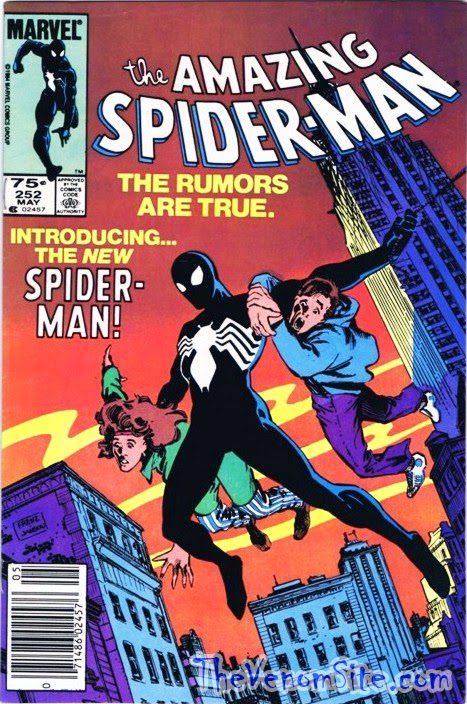
Read the first appearance of Spider-Man's black suit on the Marvel Digital Comics Unlimited app

The issue that introduced it all in the May of 1984 (The Amazing Spider-Man 252) had a cover which left most in wonder of what exactly Spider-Man was wearing and where it came from. Spider-Man was getting a revamp in the mid '80s with new and exciting stories and. most of all. new threads and powers. The suit gave Spider-Man enhanced abilities and allowed Peter to accomplish things he could not imagine. In 1984, after the release of this land mark issue, started an event by Marvel simply known as Secret Wars. Little did the Marvel world know that this series would eventually go on to explain where the black suit had originated from only a few months later.

Read the entire Marvel Superheroes Secret Wars saga on Comixology

In this random origin story, a long battle takes place between Earth's Mightiest Heroes to defeat the likes of Doctor Doom, Doc Ock, Galactus, Enchantress, and many more. A war has erupted on this mysterious alien land and "Amid the Chaos, there comes a costume!" After losing his helmet and ripping his costume in battle, Thor visits a machine which replaced his costume. Spider-Man notices his own suit being shredded, so after talking with Thor, he learned to use the mysterious machine to fix and replace pieces of his outfit. What came next was of complete mystery to the web head and thus the symbiote was born.

Discover the secrets behind Spider-Man's iconic black costume origin in Brian Michael Bendis' upcoming Guardians of the Galaxy: Planet Venom

Now for some clarity, this machine was home to what we now know as the Venom symbiote, but what exactly was the symbiote doing inside the machine and how did it get there? Some ideas I have come up with may shed some light on the whole situation. Is it possible that the symbiote had somehow managed to trap itself in the machine? It could have very well accidentally stumbled onto this alien world attached to a ship and found itself waiting for its next victim to latch onto and bond with by hiding within the machine.

For scenario number two, could the symbiote have been attached to a previous host who brought it here and this was a alternate costume for the individual? The idea that it could be the Beyonder's secret suit or weapon is plausible, in which he scientifically broke down the uses for the symbiote and learned to somehow control it. Does the Venom symbiote have a more involved past than we thought?

Finally, could it have been a project that was being worked on to develop weapons and create new matter through manipulation? The symbiote has the power to shape-shift, so why would an economical use for it be unlikely? This leads me to believe also that there could very well be more of these machines and civilizations using symbiotes to develop their armies and/or worlds.

Buy all of your Marvel Superhero Halloween costumes online at the official Marvel Shop

What can you conclude from this? Have some ideas on his origin of your own?
Feel free to share in the comment section and let me know some alternate ideas for where this story of the machine was going.

Aug 1, 2014

What If Anti-Venom Met the First Mutant Messiah?

Anti-Venom and Cable have contributed many acts of heroism to the world of Marvel—Anti-Venom with his curing touch and Cable with more powers than one can imagine. The question is if these two would have met when Cable was still a carrier of the Techno-Organic Virus, could Anti-Venom have cured him?

This virus limited Cable to his abilities. He was constantly holding back the virus to stop it from fully taking over his body, but over the years this took a toll on his mutant abilities. The virus slowly drained him to the point that he is left with very few to no abilities.

Play with Cable in his best friend Deadpool's own Deadpool video game for Xbox 360, PlayStation 3, and PCWhen Eddie Brock was touched by Mr. Negative, he was cured of his cancer but left with a symbiote reemergence he called Anti-Venom. This touch granted him new abilities, which included healing and curing people of foreign substances. With Cable being somewhat of an all-knowing time traveler seeking a cure for his disease, why did he not think of this quick fix to his long-term problem?

This also leads to questions of why Anti-Venom's healing touch was not used for others with long-term problems they wished to "cure." With Reed Richards' time traveling devices, almost anyone would be able to visit a time in the future or past when Eddie could have helped them.

Read Anti-Venom's debut in The Amazing Spider-Man: New Ways to Die digitally on Comixology for Android and iOS devices
Anti-Venom was abandoned and Eddie is now Toxin. There was talk from Cullen Bunn about bringing back Anti-Venom in Venom (Volume 2), but due to the cancellation, who knows what the Anti-Venom's future could have been?

Being two of the most popular characters of the '90s, Eddie and Nate Summers (Cable) could have been a match made in heaven, helping one another and teaming up to become one of the biggest hits out of the '90s.

We had a Deadpool vs. Carnage series, so why not a comic series in which Eddie and Nate team up? It may not be too late.

Who do you think would benefit from Eddie's healing powers? Who would you like to see Eddie team up with? Leave a comment below with your dream team!

Jul 25, 2014

Psych Ward Unabridged: Eddie Brock - Part 2 of 2

Welcome again to the conclusion of "Psych Ward Unabridged: Eddie Brock"! In the previous article, I explored Eddie's psychological roots developed from childhood into adulthood and the dynamics which were introduced when he became Venom. Let's continue, shall we?

Post-Venom Decline and Revelation

Read The Spectacular Spider-Man Vol. 2: The Hunger digitally through the Marvel Digital Comics Unlimited app for $0.99 during San Diego Comic Con 2014Eddie's emotional separation from the Venom symbiote began long before their physical separation. In the final pages of Venom: Separation Anxiety #4, Eddie's battle with the Life Foundation symbiote spawns uncovered the truth about the extent to which the human host has control in the symbiotic relationship, which caused him to contemplate his own symbiosis. Years later, his revelation would find its light when the symbiote sought a new host when Eddie's cancer returned (Spectacular Spider-Man Series 2, Volume 1: "The Hunger").

Though the symbiote failed to find a new host and remained with Eddie by Spider-Man's intervention, Eddie's relationship with it had reached its conclusion and, shortly after the incident, he auctioned off the symbiote to a mob boss and the father of the second Venom host, Angelo Fortunato, for charity (Marvel Knights Spider-Man Volume 2: "Venomous"). At this point in life, Eddie abandoned his previous quest for love and admiration, and held onto his general selflessness by donating the total sum from the auction to charity only. Unable to face a life in which he would be reminded every day of his sins as Venom, Eddie attempted suicide once more, only to fail. He was then hospitalized and treated for his cancer.

When May Parker was admitted to the same hospital after having taken a sniper bullet in the wake of Peter revealing his secret identity, Eddie's insanity from his career as Venom relapsed. Whether this was caused by trace symbiote tissue that remained in his system influencing his psychology or not is still unknown, though Eddie claims that it was, indeed, the symbiote that influenced him to attempt to murder the helpless woman. Eddie's conviction of protecting innocents like May proved stronger than the sinister influence, and he instead attempted to purge himself of the remaining symbiote traces before again attempting suicide. He survived thanks to Peter's intervention, and the event signified the final days of his instability from his career as Venom.

Read The Amazing Spider-Man: New Ways to Die online with the Marvel Comics App
From then on, Eddie sought to try to atone for his sins through charity at the local F.E.A.S.T. (Food, Emergency Aid, Shelter, and Training) kitchen as he continued his cancer therapy. His work proved beneficial to his psyche as he slowly began to realize all of the wrongs he committed, especially in blaming Spider-Man for his exposure to the alien symbiote, which he now demonizes along with its kin. Eddie relapsed only once in his violent tendencies when he mauled a homeless oppressor in a feverous rage; otherwise, Eddie proved himself a valuable member of society even to May, whom he worked alongside at the kitchen.

Another positive influence that helped Eddie cope with his cancer and sins was his faith. Though he had a Roman Catholic upbringing as a child, Eddie had never had strong religious inclinations. After ridding himself of the Venom symbiote and surviving two suicide attempts, Eddie may have returned to his faith when he related the symbiotes to demons instead of extraterrestrial beings. Whatever the cause, Eddie's faith was the vehicle that helped him find salvation through charity and atoning for his sins.

When Eddie became Anti-Venom during Venom's (then hosted by MacDonald Gargan) attack on the kitchen, his violent psychology tied to his Venom persona transformed into that of an antibody attacking a disease, reflecting the nature of the Anti-Venom faux symbiote. His faith also took on a more extreme role, and together with his hatred for symbiotes and new lease on life as a servant to the people, Eddie took on the role of an anti-hero towards any symbiotes, criminals, and any other negative outside influences he deemed to be cancers or diseases. Though Spider-Man still withheld some distrust in Eddie for his past crimes against him and his own, the fact that he eventually saw Eddie as possibly being a better person as Anti-Venom, in turn, helped Eddie to accept Spider-Man as a friend rather than a foe.

Follow Anti-Venom and Jenna Cole's adventures with the Punisher in The Amazing Spider-Man Presents: Anti-Venom: New Ways to Live
Eddie still faced the temptation for extreme violence despite his second chance, and often struggled to keep himself in check as Anti-Venom. The temptation was even stronger than before, too, since the power of his Anti-Venom faux symbiote was significantly greater than that of any symbiote's; the faux symbiote exhibited new abilities and no viable weaknesses outside of constituent matter exhaustion through over-expulsion, Mister Negative's special powers (by which the faux symbiote was mutated), and a toxin Norman Osborn developed using Freak's DNA.

The solution to Eddie's self-control issue presented itself early on in his new vigilante career in the form of Jenna Cole, a teenage drug addict whom he saved and purified. She became a physical manifestation of his conscience when he allowed her to work with him as his partner in cleaning the streets of crime and illegal drugs. Whenever she was near him, Eddie would display his best behavior and remind himself to never fall back into his old ways in the hopes of becoming a better man and a hero. Likewise, Eddie served as Jenna's guardian angel and her constant reminder to never fall under the influence again. When both were separated, their demons returned; when they reunited, their resolve to do better was established once more. Unfortunately for Eddie, this relationship did not last long—perhaps due to the dangers he exposed Jenna to, he convinced her to lead a new life without him.

Eddie soon received affirmation for his new lease on life, which provided him with a simultaneously positive and negative psychological influence. In his war against Mr. Negative, he was finally able to earn some respect from Spider-Man when Eddie revealed the villain's secret. He took this feedback from a former antagonist as an affirmation of his good work, which both improved his work as a hero and fueled his psychosis.

Relive the Anti-Venom versus Agent Venom fight in Spider-Island

Along with his psychosis, Eddie's spiritualism began to blossom as he connected his work of purifying the world with biblical context. Combined with his seeming invulnerability with the Anti-Venom faux symbiote, he began to develop a messiah complex, which only intensified with the events of Spider-Island. Eddie was one of the only individuals armed with a potential cure to the transformative virus that struck Manhattan's human and superhuman population, which put him in a position of ultimate power. That power was challenged by Agent Venom (Flash Thompson) when the symbiotic super soldier's symbiote attempted—and successfully, albeit briefly—re-bonded with Eddie when he was at his weakest.

That moment was most likely a sobering one for Eddie, as he was reminded of his own mortality and the fleeting nature of the Anti-Venom faux symbiote's power. This also may have made his decision to give up that power to save Manhattan somewhat easier along with his diminishing messiah complex. Above all, though, he made the decision based on his core quality of selfless charity. The decision and its results earned him temporary fame as he was named the hero of Spider-Island, thus validating his efforts and fulfilling his basest desires for recognition.

Regression and the Vendetta

When Eddie sacrificed his Anti-Venom faux symbiote, he sacrificed every last trace of anything in his system that could potentially give him the power to continue his vigilantism. However, his vindication towards his mission of ridding the world of symbiotes never diminished. Forgotten by the masses for his sacrifice soon after, Eddie used his remaining personal funds to arm himself for his crusade and proceeded to hunt down and neutralize both Hybrid (Scott Washington) and Scream (Donna Diego).

Read Venom: Toxin with a Vengeance digitally with Comixology on Android and iOSThe vendetta itself drove Eddie mad with vengeance and piety as his psychology fed on the remnants of his messiah complex. When he was forced to bond with the Toxin symbiote when the Crime-Master captured him, Eddie's hatred for the symbiotes surprisingly took a strange turn: instead of completely rejecting the spawn, Eddie struck a deal with it. His and the Toxin symbiote's hatred for Venom was intense enough that they allied themselves temporarily to eliminate the common threat.

The alliance eventually rekindled Eddie's Lethal Protector mentality as well through the remnants of his former messiah complex, causing him to psychologically regress and undoing his therapeutic efforts. Unlike his previous relationship with the Venom symbiote, Eddie shares no love with the Toxin symbiote, and both vowed to attempt to kill each other once they've rid the world of Venom and its other spawn. After he helped Agent Venom to defend West Philadelphia High School from a pack of Symbiote Slayers, Eddie again came to the same realization he had years before with Spider-Man (Amazing Spider-Man #375) about Flash's good work as Agent Venom and allowed him to continue as a hero until the day came when Flash lost complete control of the symbiote. It is unclear if the second revelation has any impact on his own psyche, but for now Eddie remains unchanged in his Lethal Protector psychology and his hatred for all symbiotes.

Conclusion

Given over 25 years of history and material, an interesting overarching theme to Eddie's character seems to develop. Much in the way that Eddie's victimhood and lack of responsibility when given great power are his core characteristics, so, too, is the nature of symbiosis. According to the Merriam-Webster Dictionary, symbiosis is defined as "the relationship between two different kinds of living things that live together and depend on each other." This is mostly true for the alien symbiote race, as I had explained in a previous article; however, this definition also applies to Eddie as a character.

As I had mentioned earlier, had Eddie never bonded with the Venom symbiote in the first place, he would have killed himself or lived on and become consumed by cancer. With the symbiote's intervention, he survived. Now, this is a very on-the-surface analysis of Eddie's symbiotic characteristic, but there is another level to it: up until his initial bond, Eddie was unable to survive alone in a harsh world that rejected him. His victim complex signified this inability, and it wasn't until he was bonded with the symbiote that he was given the strength to survive, both physically and emotionally.

What I'm proposing is that Eddie is a human symbiote—not in the sense that he was born a mutant, but that his circumstances turned him into one psychologically. He requires emotional partnership in which he can receive the support he needs to fight his victim complex and provide, in turn, physical support. This trait is apparent in all three of his vigilante personas. As Venom, the symbiote provided him an exclusive partnership in which it sympathized with his victimhood and frustrations while he provided the symbiote with a viable host. As Anti-Venom, his the symbiotic dynamic shifts from between Eddie and his non-sentient faux symbiote to between Eddie and Jenna; Jenna provided him a physical embodiment of his conscience and a reminder of his desire to become the hero he wants to be while Eddie provides her with a similar service and protection as Anti-Venom. Finally, as Toxin, the dynamic shifts back to between Eddie and the symbiote, but is also altered: instead of providing Eddie any emotional or psychological support, the symbiote provides him the power necessary to combat other symbiotes while Eddie provides it with a temporary host.

Any way one chooses to view this point, it becomes apparent that Eddie is indeed a type of symbiote himself. Whenever he lacked a bond to a symbiote or someone to provide him the emotional or psychological balance he required, his antics were self-destructive, to sum the point up. Even when he was bereft of his Anti-Venom faux symbiote and before he bonded with the Toxin symbiote, Eddie quickly became psychologically imbalanced—he was manic, ruthless, and a danger to himself and others. He may have had the knowledge and tools to take on his enemy—the symbiotes—but he could have easily been killed when he was captured by the Crime-Master. Add to that example all of the other times Eddie was without support, and it becomes apparent that he would have eventually died in every instance. Therefore, Eddie requires emotional and psychological support from an outside source to appease his victim complex and help him function just enough to survive.


So ends my analysis of Eddie's psychology. I hope you found this article series interesting, if not educational. I promise to update it in the future whenever his psychology takes on a new aspect. If you have any questions, comments, or suggestions for improving "Psych Ward Unabridged," please direct them to the comments section below. Don't forget to check back here on A Dose of Venom for new content, and make sure to visit The Venom Site for all of your symbiote news, reviews, and point-of-views!

Jul 18, 2014

Psych Ward Unabridged: Eddie Brock - Part 1 of 2

Welcome back to A Dose of Venom! The last time I wrote, I introduced you to the biology and habits of the alien symbiote race in an in-depth, partially scientific study. Today, I'm going to continue this theme of deconstructing the comics by analyzing the psychological profile of the most well-known and loved symbiote host: Edward Charles Allan Brock, formerly Venom and Anti-Venom, and currently Toxin.

This was previously attempted by Tim Stevens, Marvel's official "Psych Ward" column writer, who is pursuing his Psy D. I am not pursuing any such psychology degree, nor am I a professional psychologist; I merely hold an (unhealthy) interest in the psychology of fictional characters and am very apt at Googling psychological and medical jargon. I felt that Stevens' own analysis of Eddie's psychology as Venom (or, more specifically, his psychology between giving up the symbiote and becoming Anti-Venom) was quite informative and entertaining; however, I also felt that it didn't completely encompass the psychology and motivation of the character, especially since Eddie has evolved so much since the time of the original article's publication. This two-part article series will explore even further into Eddie's psychology, how it developed, and how it has evolved through his careers as Venom, Anti-Venom, and Toxin.

Preliminary Analysis

Read Eddie Brock's origin in Venom: Lethal Protector digitally on ComixologyBefore Eddie's birth, his parents—Carl and Jaime Brock—had a daughter: Mary, Eddie's older sibling. After she was born, it was revealed to the parents that Jaime couldn't bear another child without seriously risking her life. When she became pregnant with Eddie, Carl expressed his concern for his wife's health, but to no avail; she was determined to have her child, regardless of the risk. Consequently, she passed away shortly after giving birth to Eddie, which immediately fostered Carl's hatred for his son, whom he blamed for killing his beloved wife.

Despite his feelings for Eddie, Carl was a fair and honorable father, and saw to it that Eddie received the best education in honor of Jaime's memory. However financially invested he was in Eddie's future, Carl was never emotionally invested in his own son. Along with Mary's adolescent insincerity towards her younger brother, whom she also, for a time, blamed for her mother's death, Eddie developed early on a victim complex.

He felt himself innocent of his mother's death, and constantly tried to please his father through academic and athletic achievement throughout his schooling. His yearning for validation spilled into his social life as well, and he often attempted feats that would earn him the favor of his peers. His intentions have always been for the best, though as he aged, the means by which he sought praise degraded into the immoral and unethical.

Consult your local family psychologist for issues between parents and children

Love and admiration are Eddie's primary motivators; success and fame were never his goals. In fact, Eddie may have developed a distaste for wealth from his upbringing; he was born into a wealthy family who lived in one of the wealthiest neighborhoods of San Francisco, CA, but because of his father's disinterest and apathy for his son, Eddie may relate wealth and success with negative feelings. Eddie is markedly charitable and sympathetic: he had donated the proceeds from auctioning off the Venom symbiote (Marvel Knights Spider-Man: Venomous) to fifty different charities and, when he isn't blinded by his rage, is always mindful of and protects people's innocence.

Get ripped with Insanity body training workout course on a free trial
Eddie found very few avenues of true happiness in his adolescence and teenage years, but the few avenues he did find consisted of physical activity. As a child, he loved to skateboard with his friends and excelled in the pastime, thus earning him the desired praise from his peers (Venom: The Hunted). When Eddie entered high school, he directed his efforts to please his father away from academics and onto football, believing that maybe he could succeed in a non-academic manner. Even though he was met with the same disinterest from his father, Eddie's physicality from his short football career built upon his physicality later on as he found enjoyment in building muscle to best Spider-Man in combat.

Returning to the nature of the modes by which he sought validation, Eddie never related the immorality of his unethical actions to negativity. He possesses a twisted sense of morality in which he can differentiate morality in others, but not in himself. For instance, when Eddie was a young child, he intentionally kidnapped and held hostage a peer's kitten in order to fabricate a search and rescue situation in which he would emerge the hero and earn the respective praise. His dishonesty and disregard for personal accountability blossomed in his journalistic career later in life when he both lied about having an internship with the San Francisco Chronicle for admission into Empire State University and withheld Emil Gregg's identity from the NYPD in the name of the First Amendment in order to continue writing his popular interview series with the Sin Eater copycat for the Daily Globe (Venom: Dark Origin).

Read Ann Weying's introduction in the pages of Spider-Man: Vengeance of Venom trade paperback available on Amazon

Another cause for Eddie's moral degeneration can be rooted back to his first exposure to career journalism. In grade school, one of his teachers (most likely an American history teacher) delivered a lecture on the Watergate scandal and how truth is determined by journalists. Eddie would later utilize this lesson in his interviews with the Sin Eater copycat to institute Emil as the true criminal prior to Spider-Man revealing the real culprit.

Combined with his twisted sense of morality, the core of Eddie's character is established to mock that of Spider-Man's: when Eddie is provided great power, he lacks any sense of responsibility or accountability. He never once blamed himself for his own misfortune or for his crimes as Venom, and instead shifted blame onto others, especially Spider-Man.

The Psychological Symbiosis of Venom

At the time of Eddie's initial bonding with the alien symbiote, his victim complex was at its peak. Through the downward spiral of losing his job, respect, and college sweetheart-turned-wife Ann Weying after the Sin Eater debacle, Eddie no longer saw any hope for validation as a human being. Added to his situation were a new dead-end job as a tabloid journalist writing false truths and exposés and the discovery of his cancer, which jointly advanced his degradation to the point of suicide.

Countdown the Top 5 Venom Artists of All Time on The Venom Site A Dose of VenomHad the symbiote not intervened during his suicide attempt, it would have resulted in Eddie's death—both his immediate death by suicide and his slower death by cancer, which the symbiote seemingly eradicated. When the symbiote did intervene and bond with him, though, it not only saved his life, but gave Eddie new purpose to live. The symbiote, too, suffers from a victim complex after having been rejected by its own species for being insane, captured and imprisoned on Battleworld, and then brought to Earth and rejected by its former and most intimate host, Peter Parker.

Together, Eddie and the symbiote created a complimentary psychological bond that provided them an exclusive, empathetic companionship. Though the symbiote always sought a chance to bond once more with Spider-Man, its hatred for him and its familiarity with Eddie's experiences influenced the symbiote to stay with him and create a close working relationship.

Read Venom: Dark Origin digitally on Marvel Digital Comics Unlimited for Android and iOSAs is the case with the symbiote's current host, Eugene "Flash" Thompson, Eddie developed a dependency for the symbiote similar to that an alcoholic has for alcohol or an addict has for drugs. The power and strength it provided him to conquer his outward oppressors became intoxicating to the point in which his and the symbiote's individually experienced pain and pleasure became sympathetic. Unlike when the symbiote bonded with Spider-Man, Eddie and the symbiote shared a more explicit relationship in which the symbiote played a more proactive role, and would sometimes overpower Eddie's own psychology. Because of this complex relationship, Eddie's modus operandi became vague, as Daredevil had revealed in Spider-Man Special Edition: The Trial of Venom (1992). Whether Eddie can be held accountable for his crimes as Venom is debatable, especially when he reverts to his previously nonviolent nature during the periods in which he is completely detached from the symbiote (excluding his violent vendetta against symbiotes; he is largely nonviolent towards other humans). In fact, before he became Anti-Venom, Eddie would typically revert to his original, damaged psyche, and has been known to re-attempt suicide.

Though his relationship with the Venom symbiote removes his own self-destructive psychology in place of strength, that strength is tempered only by vengeance. Venom (the amalgam of Eddie and the symbiote) may lean toward vigilantism and heroics at times in his quest to protect the innocent, but vengeance is his priority and modus operandi. He has been known to overlook his heroic responsibilities and even revert to murderous intents in a fit of rage caused by outward aggressors, especially Spider-Man. Therefore, as much good as bonding with the symbiote did for Eddie's fragile psyche, it also set him on a downward path of long-term self-destruction.


This concludes the first part to "Psych Ward Unabridged." Return to A Dose of Venom next Friday for the conclusion, in which I explore Eddie's evolution as Anti-Venom and his de-evolution as Toxin. If you feel I've missed an important point in the analysis so far or have any questions or comments, let me know in the comments section below, and don't forget to follow The Venom Site for all of your symbiote news, reviews, and point-of-views!

Jul 11, 2014

Ineffigiatus parasitus: A Study of Marvel's Perplexing Alien Symbiote Species

Welcome to A Dose of Venom! What is this blog site all about? Well, that's pretty simple: it's about Spider-Man's nemesis, Venom, and the race of alien symbiotes that have spawned from the character. More specifically, though, the blog site is a place for contributors from The Venom Site to let loose and share with you, the readers, our fandom. To get started, let's explore what symbiotes are exactly.

The Marvel Universe is filled with imaginative creatures and beings of various curiosities and abilities, but up until now, one of the most reader-popular species has been as amorphous in its nature as it appears in print. The symbiote—once thought to be a super-science wonder material discovered by Spider-Man on Battleworld during The Secret Wars of 1984–85—has been a character of awe and bad-assery since its first appearance.

It has been 30 years since the creature's debut, and it has spawned numerous iterations of itself and offspring, including popular characters Venom (the result of Spider-Man's living costume bonding to scorned journalist Eddie Brock), one of the web crawler's deadliest foes; and Carnage, it's even deadlier offspring. Many writers and artists have graced their readers with hundreds of interesting and unique takes on the symbiote, but with the variety came discontinuity. A clear portrait of the symbiote's biology, characteristics, and nature has never been achieved. In this analysis, I will take all 30 years' worth of information and input into these properties and consolidate it all into one cohesive explanation of how and why the symbiote is what it is and does what it does.

Read Mighty Avengers Volume 2: Venom Bomb on Comixology

Before I begin, I want to make one important note. Even though the topical species is officially titled "symbiote," that particular species classification is debatable. This will be explained towards the end of the analysis. I'll unofficially assign the species the taxonomy Ineffigiatus parasitus (Latin for "Amorphous parasite"), but for simplicity and in respect of the property and its fan base, I'll continue to use "symbiote" in reference to the species as a whole and its individual members.

Section I: Diet

First, let's address a symbiote's desires from its symbiotic relationship. Symbiotes seek two nutritional resources: phenethylamine and adrenaline.

Adrenaline (epinephrine) is primary in a symbiote's diet, evidenced by Spider-Man's repeated blackouts during the time he played host to the Venom symbiote. The symbiote would take control of Spider-Man's body when he slept and ventured into the night for a little web slinging and crime fighting. Instead of being a thrill junkie as Spider-Man had surmised, the symbiote merely required a balanced diet of adrenaline—something Spider-Man could easily provide with the help of his powers, making Spider-Man the Venom symbiote's most sought-after host.

The reason why adrenaline is primary to a symbiote's diet is never touched upon in the comics, but considering the function of the hormone, it's safe to assume that adrenaline plays a part in the way a symbiote functions. Adrenaline is an agonist, meaning that it binds itself to a chemical receptor and activates it to produce a biological response. We can therefore assume that the symbiote utilizes adrenaline to govern its physical and biological responses, including mobility, amorphous abilities, and digestion.

Relive the horror of Venom: The Hunger on Marvel Digital Comics Unlimited
The second most important part of a symbiote's diet is also the food source that physically holds the symbiote together. Phenethylamine is most often extracted by the Venom symbiote from two sources on Earth: human brains and chocolate. It is assumed symbiotes prefer brains over chocolate ("We want to eat your brains!" becoming Venom's famous tagline) because of the relatively higher concentration of phenethylamine in brain tissue. If consumed in mass quantities, symbiotes can theoretically sustain themselves with chocolate, as was depicted when Brock had learned this after the Venom symbiote went on a brain-eating rampage in Venom: The Hunger.

Human brains produce sufficient amounts of beta-phenethylamine (PEA), and since it's been scientifically proven that PEA has a sort of youth elixir property to it for both physical and mental health, it is assumed PEA is a symbiote's primary choice of sustenance over the phenethylamine found in chocolate. The reason to this preference will be explained shortly.

Section II: Weaknesses

Now, to truly understand a symbiote's biology, one must understand its weaknesses. Symbiotes possess three natural weaknesses: intense thermal radiation (or more simply put, fire), high frequency sounds (sonics), and Brock's Anti-Venom antibodies. The third is a newer development and the most unique of the three, as the antibodies are synthesized by the fusion of human white blood cells and mutated symbiote tissue. The antibodies act like white blood cells, attacking and incinerating normal symbiote tissue.

Marvel Select Agent Venom action figure Disney Store ExclusiveThe nature of the other weaknesses (fire and sonics) suggests that symbiote tissue is unstable or weak in its molecular bonds. It should be noted that Hellfire supposedly has no effect on symbiote tissue, as demonstrated in Venom: Circle of Four. Additionally, microwaves have proven to be a most effective weapon against symbiotes as it combines both intense heat and vibration waves similar to sonics.


This instability accounts for a symbiote's amorphous physiology. It also explains the symbiote's diet of phenethylamine, particularly PEA; the instability of a symbiote's molecular bonds gives rise to a problem of rapid aging and organic degeneration, so the symbiote consumes and metabolizes PEA to constantly renew the strength of its molecular bonds. In short, symbiotes eat PEA to stay young, healthy, and alive. A disruption or the destruction of a symbiote's molecular bonds via fire and sonics cause the organism intense pain and agony, and can result in death by disintegration.

Section III: Physiology

As a symbiote is an amorphous organism, its physiological structure is a mystery. It can be assumed that its organs are amorphous as well, and can be naturally and cleverly concealed in its mass. Symbiotes do apparently possess organs, as evidenced by the Xenophage's (a symbiote's only known natural predator besides Anti-Venom) diet of symbiote brains and the Secret Avenger's efforts to "neuter" the Venom symbiote to reduce its ferocity. Besides a symbiote's brains and reproductive system, it is unknown whatever else a symbiote possesses for organs. It's unclear what kind of sensory system a symbiote possesses as well, but the Carnage symbiote has proven that the symbiote is able to "see" in full spherical 360°.

As with any organism, a symbiote must possess a waste removal system. I have postulated that a symbiote expends its waste by detaching portions of its tissue loaded with waste, which—like with any detached extension of a symbiote's tissue—totally and rapidly deteriorates.

A symbiote's mass potential is great, but not infinite. The extent of its tissue growth is dependent on two factors: whether it's bonded to a host organism and the amount of nutrition that is available at the given time. The symbiote can achieve a range of physical states spanning from solid to liquid, but has yet to exhibit a gaseous form. Both the Venom and Carnage symbiote have achieved a digital state in Venom: Carnage Unleashed, suggesting that symbiotes are extremely adaptive to their environment.

Revisit Carnage's origin in Spider-Man: Vengeance of Venom trade paperback available on AmazonTraditional symbiotes cannot maintain the cohesiveness of the molecular bonds of a detached piece of tissue for long, but through evolution the Carnage symbiote and its offspring have been able to develop projectile weapon constructs made of their tissue that last much longer from the point of detachment. Symbiotes can develop a number of materials from their own tissue that are able to withstand the test of time to greater lengths than simple extensions of their mass—one example being the organic webbing the Venom symbiote learned to develop and perfect apart from Spider-Man's chemical webbing.

The symbiotes' constituent matter possesses two unique attributes, as well. First, a group of symbiotes can combine their matter into a single amalgam organism. This was first revealed in the case of Scott Washington and his Hybrid symbiote, which was originally four of the five Life Foundation symbiote spawns derived from the Venom symbiote. The amalgam symbiote, however, can be broken back down into its constituent parts, as was the case when the original Hybrid symbiotes were transferred to four U.S. Special Forces soldiers during Carnage: U.S.A. after Washington's death at the hands of Brock.

Lastly, the symbiotes' tissue possesses an exotic attribute that can decay the very fabric of the Microverse. The symbiotes once breached the Microverse in its ancient history and nearly destroyed it as the species rapidly propagated and corrupted its space-time fabric. The inhabitants of the Microverse were able to fight back and expel the symbiotes from the Microverse, thus preventing its destruction.

Part IV: Bonding

As to bonding with a host, a symbiote naturally only maintains a temporary bond until it has drained the host organism of the required nutrition, often leading to the host's demise. This relationship between the host and the symbiote often straddles the border between symbiotic and parasitic, with the symbiote offering only minimal benefits to the host. This is also true because, for the most part, the symbiote establishes itself as the dominant partner in the relationship, making the host all but powerless. There is a 48-hour window starting from the time of a symbiote's contact with a human host before the symbiote can assume a complex, "full" bond. The timer resets every time the physical connection is severed.

The Venom symbiote was the first to actively pursue a more symbiotic and permanent bond with a host as a result of a steady psychological degeneration over generations of spawns (which the greater symbiote populace refers to as "insanity"). The Venom symbiote can't bond to its host permanently as it hopes it could, but it can leave in its host organism traces of itself that can survive long past the natural expiry and allow for simplicity in future bonds if the symbiote and its host somehow become detached from each other.

Buy the Sam Raimi Spider-Man Trilogy on Blu-ray

Venom's offspring, Carnage, is the very first symbiote in the race's history to actually achieve a permanent bond with its first host, Cletus Kasady, by bonding at a molecular level. A large part of Carnage's constituent mass can be separated from the host and survive for a short time after disconnection, but the symbiote traces in Kasady's molecules can completely regenerate into the full symbiote organism at will once the separated mass reestablishes physical contact with Kasady or, assumingly, over an extended period time as the traces regenerate the symbiote's mass. Separation between Kasady and the Carnage symbiote is impossible without killing both organisms, whereas separation between any of the Venom symbiote's hosts and the symbiote itself is merely scarring and painful to both organisms.

Logically, this means that every true spawn after Carnage (i.e. Toxin) is able to achieve a permanent bond. The Toxin symbiote may have been unable to achieve a permanent bond with its first host, Patrick Mulligan, before it was forcefully separated from him by the Blackheart demon due to its infancy; however, the Carnage symbiote and Kasady were apparently able to quickly achieve a permanent bond not long after the symbiote's birth.

In Venom: On Trial, the neurotoxin MPTP (1-methyl-4-phenyl-1,2,3,6-tetrahydropyridine) was used to sever the symbiote's nerve tissue communication link with the human host, effectively disconnecting the symbiote and host's bond. The neurotoxin prevents the host's brain from producing dopamine, which the symbiote uses to establish a neural connection. MPTP, however, has since proven ineffective since the symbiote uses the host's adrenaline to create a counter to the neurotoxin—meaning that the symbiote can reestablish its neural bond with its host should the host become excited. This loophole renders MPTP as only a temporary solution to severing the bond.

Part V: Extrasensory Attributes

Symbiotes are susceptible to psychic influence; on the other side of that coin, they also possess psychic characteristics and abilities. Symbiotes can communicate among one another and their hosts through both a neural and a psychic connection. Whether this ability is natural or had been acquired by a common ancestor is still unknown, so for all intensive purposes, I shall state that these psychic characteristics are natural (consider: Charles Xavier of the X-Men acquired psychic abilities through natural mutation, most likely involving a greater use of his brain's potential than a normal human being's; perhaps the symbiote brain possesses a psychic receptor and other appendages).

The most powerful psychic influence a symbiote can experience is emotion. Symbiotes naturally lack emotion; however, their tolerance for psycho-emotional influence is extremely delicate and directly affects both their physiology and psychology. Any kind of psychic overload can prove detrimental—even fatal, as demonstrated in both the Planet of the Symbiotes and Minimum Carnage storylines when both Venom and Agent Venom used a "psychic scream," in which the symbiote and its host released a powerful emotional burst through the symbiotes' collective psychic communications network. Insanity, as exhibited in the Venom symbiote line and the Krobaa symbiote, is a most common result of a symbiote's psyche becoming imbalanced.

Part VI: Reproduction

As to the topic of reproduction, symbiotes spawn asexually and possess the ability to produce only one true spawn. Symbiotes can also produce additional spawn, but these are most likely spawn cloned from the original reproducer (both evolved/differentiated and carbon copies). The true spawn is more powerful than its reproducer and the reproducer's spawned copies. Every spawn, true and copied, is evolved to a degree from their parent and exhibits and learns new abilities and characteristics with each generation, all the while carrying their predecessors' abilities, characteristics, and ancestral memory (the Carnage symbiote was able to instinctively recall an ancient memory in which the symbiote race recognized the Silver Surfer as an enemy in the Web of Carnage story) passed down in a form of genetic memory. Therefore, whatever the predecessor learned or inherited will be passed down to the new spawn.

Read Venom vs Carnage on the Marvel Comics App for Android and iOS
As revealed in Venom vs. Carnage, every thousandth (1,000th) spawn generation in a family line suffers a complete mental breakdown, resulting in the spawn's psyche becoming completely malleable to external influences. Toxin was the thousandth spawn in Venom's line, and Venom declared itself to be the 998th spawn, supporting the theory that symbiotes only spawn one true offspring per reproducer. Venom, Carnage, and Toxin are all the known true symbiote spawns in Venom's line present in the mainstream (616) Marvel Universe.

The reproducing parent symbiote and its spawn naturally antagonize each other to the point of homicidal intent. This is due in part to their violent nature and a struggle for precious nutritional resources. This murderous relationship can be thought of as a Darwinist one: a survival of the fittest between parent and offspring.

An event known only as "The Spawning" has been teased by both Rick Remender and Cullen Bunn (writers of the late Venom (2011–2013) title), but how the Spawning affects symbiote reproduction has yet to be revealed to the general public. I assume it may be correlated to a species-wide shared reproductive event involving the rapid spawning of more than one true spawn per reproducer. If the event ever does come about in the comics, I will update this piece accordingly.

Part VII: Symbiote–Human Relations

As to the other end of a symbiotic relationship, we shall now explore the benefits a host organism receives from a symbiote. Traditionally, a symbiote restricts the benefits it offers to its host to a minimum, preferring complete dominion with little to no resistance or compromise. A symbiote will keep its host alive long enough to extract the required nourishment, granting the host limited boosts in strength, abilities, and health for the host to execute self-preservation and to protect the symbiote from harm and danger.

Though the symbiote feeds on PEA, thusly reducing the host's lifespan dramatically, the symbiote substitutes the loss of PEA with a synthesized substance to keep the host alive until the PEA has been completely extracted, resulting in a quick death for the host. The symbiote synthesizes and provides basic nutrition for its host, especially medical care in the form of an increased healing factor closely related to, but significantly weaker than that exhibited in mutants such as Wolverine and Deadpool.

Read Angelo Fortunato's tragic tale as Venom in Marvel Knights Spider-Man: Venomous

Overall, symbiotes traditionally try to maintain their hosts' status quo in health and well-being and care little, if at all, when the host dies after detachment. The value and quality of a symbiote's care plays in the symbiote's favor as well: the host organism becomes dependent and addicted to the symbiote's "gifts," and increased exposure to a symbiote makes it harder for a host to give up the bond, regardless of the symbiote's true intent. The Venom symbiote and its offspring, however, are more caring about their hosts than the rest of the hosts' species (again, resulting from the psychological degeneration). This may also result from a stronger emotional attachment to their hosts, considering humanity's emotional strength and influence. A notable example of this line's stronger attachment to their hosts is the Venom symbiote's selfless sacrifice for Spider-Man's life; under this circumstance, a "normal" symbiote would have sacrificed its host to save itself.

Conclusion

In the end, what have I learned from all of my efforts to give the symbiotes continuity in their nature and biology? The powers-that-be at Marvel did not really put much thought into continuity about minor details back when Venom and Carnage boomed in popularity in the '90s; at least not like über-fans like I do these days. (I'm not the only one…right?) I'm a detail junkie, and I love it when things and processes are explained. It's like bringing fiction into reality, even if most people read fiction to escape reality.

I began this effort because I wanted to understand what it would be like if symbiotes were actually real, and I've come to a logical conclusion: if symbiotes were real, we'd be lucky if we bonded to the "crazy" ones like Venom and its offspring. Symbiotes really are a violent, harsh, uncaring species, bent on self-preservation and domination. But they are cool as hell, too. So would I want symbiotes to be real? No. I'd prefer if they stayed in the pulps where they belong, and should be appreciated from a distance.

Did you make it to the end of this long first article? Congratulations! This will probably (most likely) be the longest article you'll see published here on A Dose of Venom, so the rest should be downhill—or is it uphill?—from here. Let me know if you have any questions or suggestions about this article in the comments section below, and stay tuned for new content on this blog every Friday!